Give Small Pictures a Place Together
Small pictures gain presence through their relationship to one another, not through a crowded frame around every inch of wall.
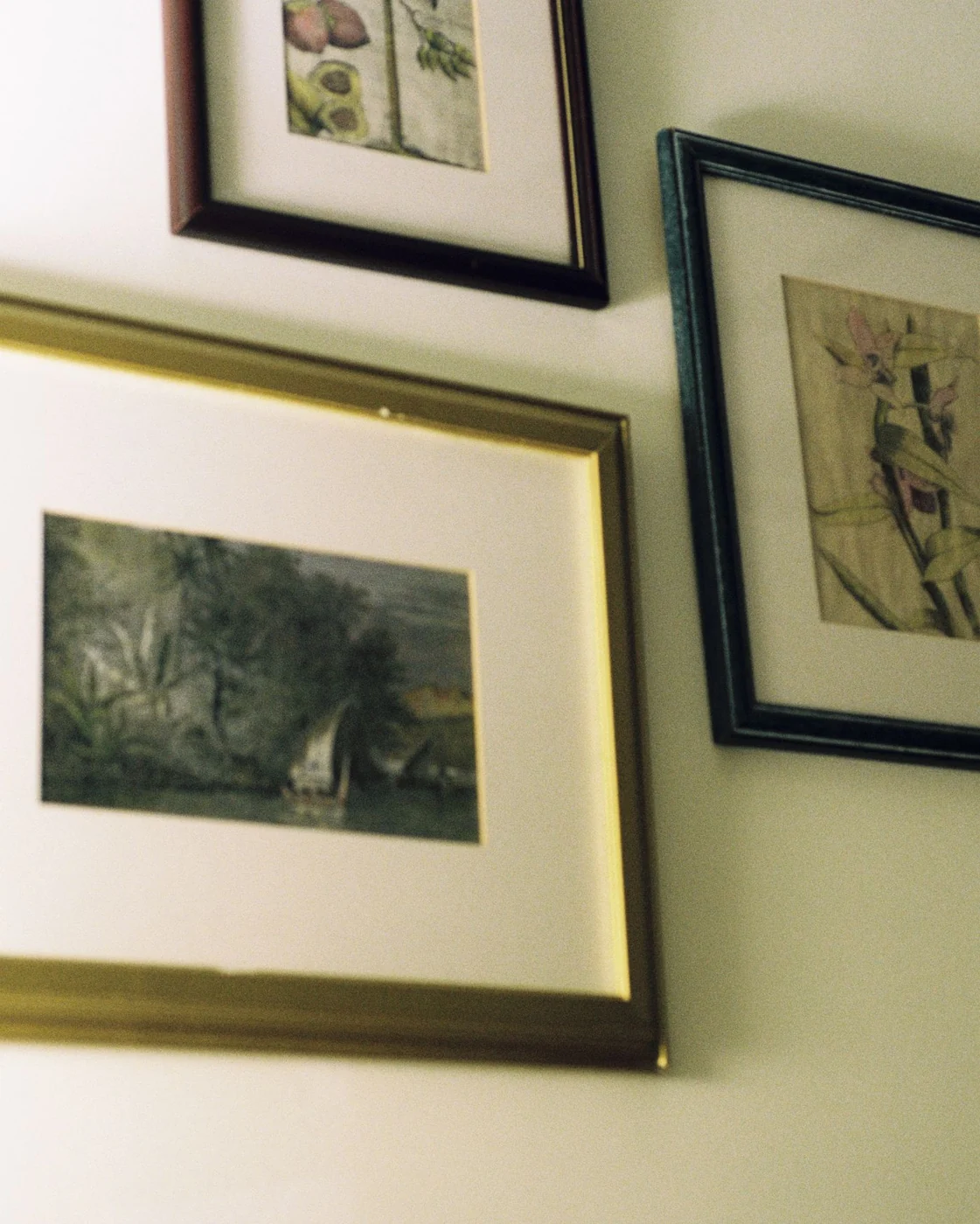
A postcard, a little landscape, and a small drawing can disappear when hung separately around a large room. Bringing them together gives each one a context. The group does not need to look like a preassembled gallery-wall kit, but it does need an understandable shape.
Lay the pieces on a table or the floor and notice what connects them. It might be a similar mood, related subject matter, or a color that appears quietly in several works. You do not need to add an unrelated picture simply because it has the right dimensions. Begin with the pieces you actually want to see together.
Choose a loose outer boundary. A compact rectangle is straightforward above a small cabinet; a taller arrangement may suit a narrow wall. The boundary can remain irregular, but knowing its general shape prevents the group from spreading until it loses its identity.
Make paper versions first
Trace the outside of each frame onto paper and mark which way it faces. Place the templates using a method suitable for the wall finish. This lets you examine the spaces between frames without repeatedly making holes. Step back far enough to see the group alongside the furniture below it.
The gaps do not have to be identical, but they should look deliberate. A tiny picture separated by an unusually large gap may appear forgotten. Move it closer to a stronger piece or give it a different role in the arrangement. Let one picture provide an anchor while the others respond to it.
Do not automatically align every top edge. Some groups work better around a shared middle area or a strong horizontal line made by two frames. Experiment with a few options, then choose the one that lets the images remain distinct. Too much clever staggering can make a quiet collection feel busy.
Before hanging, account for the frame's hardware and the actual wall material, following the appropriate instructions. The paper layout describes the composition; it does not determine the correct fixing method.
Leave room for the collection to remain small. A successful group of four pieces does not need to become twelve. If a new picture arrives later, reassess the arrangement rather than adding it to the nearest edge automatically. The pleasure of small art is often the chance to look closely, and that becomes harder when every available space demands equal attention.