A Work Corner in a Shared Room
Give work a defined place and a believable end-of-day routine, even when the desk shares a living or dining room.
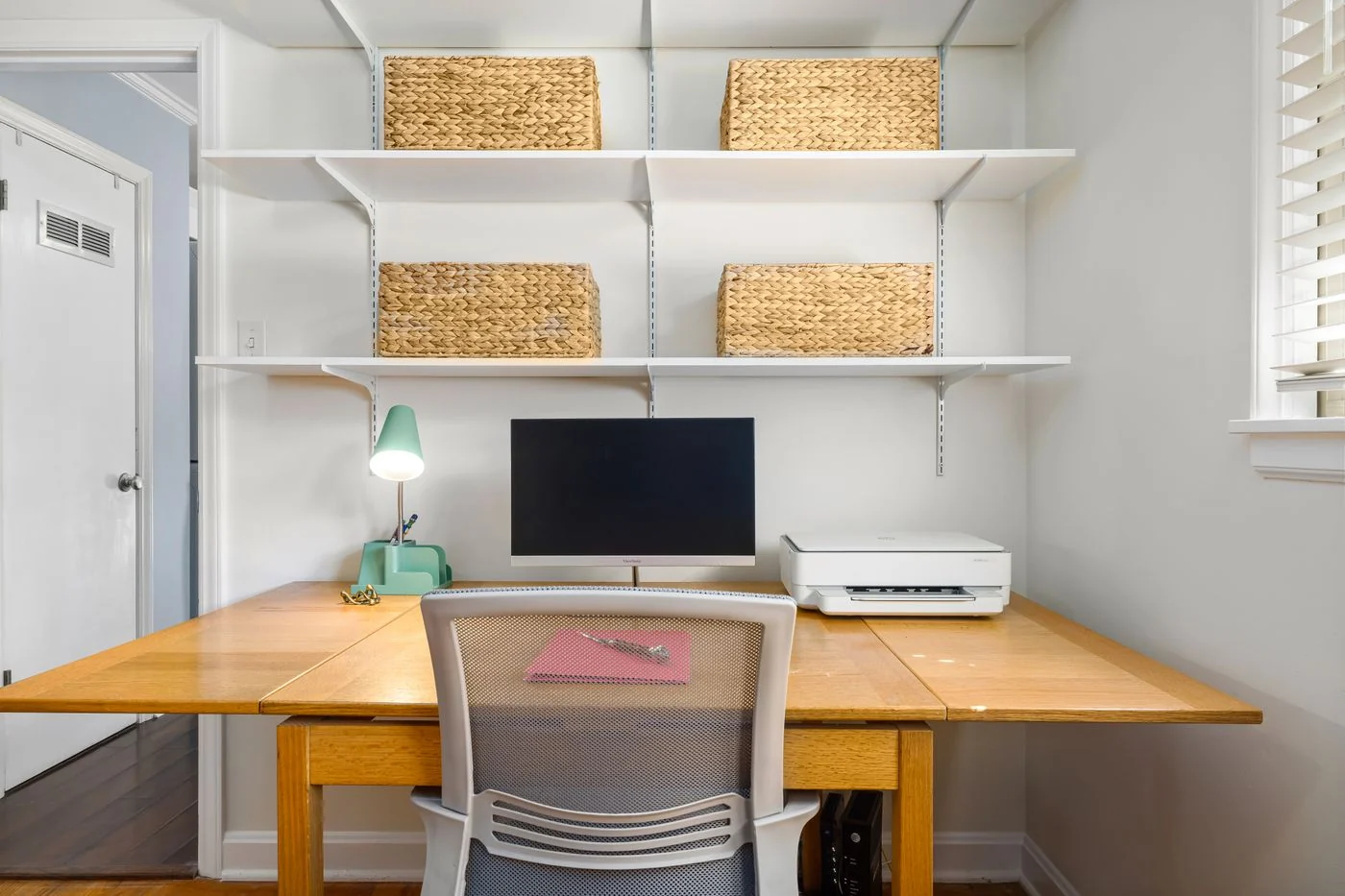
A desk in a shared room can work well until the work begins spreading. Papers move onto the dining table, chargers remain across the floor, and a laptop stays open beside the sofa all evening. The desk itself may be compact, but its activity has no boundary.
Start by listing the equipment and materials used during a normal work session. Include the items often omitted from attractive desk photographs: charging cables, notes, a headset, and anything that must stay within reach. Choose a work surface that accommodates the real task, and use appropriate ergonomic guidance for the setup rather than assuming a small decorative desk will suit prolonged work.
Separate daily access from storage
Keep frequently used items near the desk and move occasional supplies to suitable storage elsewhere. A drawer or closed cabinet can reduce visual spillover, but only if it is convenient enough to use. If putting away a notebook requires moving several decorative objects, the notebook will probably remain on the table.
The boundary can be visual without becoming a physical barrier. A desk facing a suitable wall, a clearly defined shelf area, or a simple arrangement of furniture may be enough. A screen consumes floor space and can obstruct light or movement, so add one only if it solves an actual problem.
Consider everyone who uses the room. A chair pulled back from the desk may enter the main walking route. Video calls may conflict with television viewing or family meals. Furniture placement cannot resolve every scheduling issue, but it can avoid making those conflicts worse. Test the arrangement during the busiest shared period, not only when the room is empty.
Give the equipment a closed state
Decide what the room should look like when work stops. The laptop may close and stay on the desk; papers may slide into a specific drawer; a headset may return to a hook or compartment appropriate to it. The routine should take little effort and should not require pretending the workspace has disappeared completely.
Keep cords managed according to the equipment's instructions and clear of walking routes. Do not make the final arrangement depend on unsuitable extension setups or trapped cables. If additional electrical provision is needed, address that properly rather than hiding the problem behind a basket.
Decorative pieces can help the desk belong to the room, but they should not consume its working area. A picture above it or a useful lamp may be enough. Avoid styling the surface so fully that every work session begins by clearing it.
A workable evening reset
Consider a desk used beside a living-room sofa. The working setup might include a laptop, a notebook, and a headset. A single drawer can receive the notebook and headset, while the laptop closes on the desk and the chair slides in. That is a complete reset even though the desk remains visibly a desk. It is more believable than a plan requiring all equipment to be carried to a distant closet every evening.
If the same table must also serve dinner, the requirements are different. The equipment needs an appropriate nearby destination that can accept it without disconnecting and tangling everything unnecessarily. A portable container may hold papers, but it must not crush equipment or cover ventilation while devices operate. Plan the transition around the actual products and instructions.
A shared room also benefits from an agreed signal that work is finished. It might be the closed laptop or the cleared table rather than a decorative screen. The physical arrangement can support that agreement, but it cannot replace a conversation about how the room is shared.
After a week, inspect where the overflow appears. It may reveal that the desk lacks one useful drawer, that a particular task needs another surface, or that the end-of-day routine is unrealistic. Make the smallest change that addresses the observed problem. A shared-room office succeeds when work can happen fully and then become a quieter part of the room again.