A Little Toile Goes a Long Way
A detailed scenic print rewards a closer look. It rarely needs to cover every soft surface to make its presence felt.
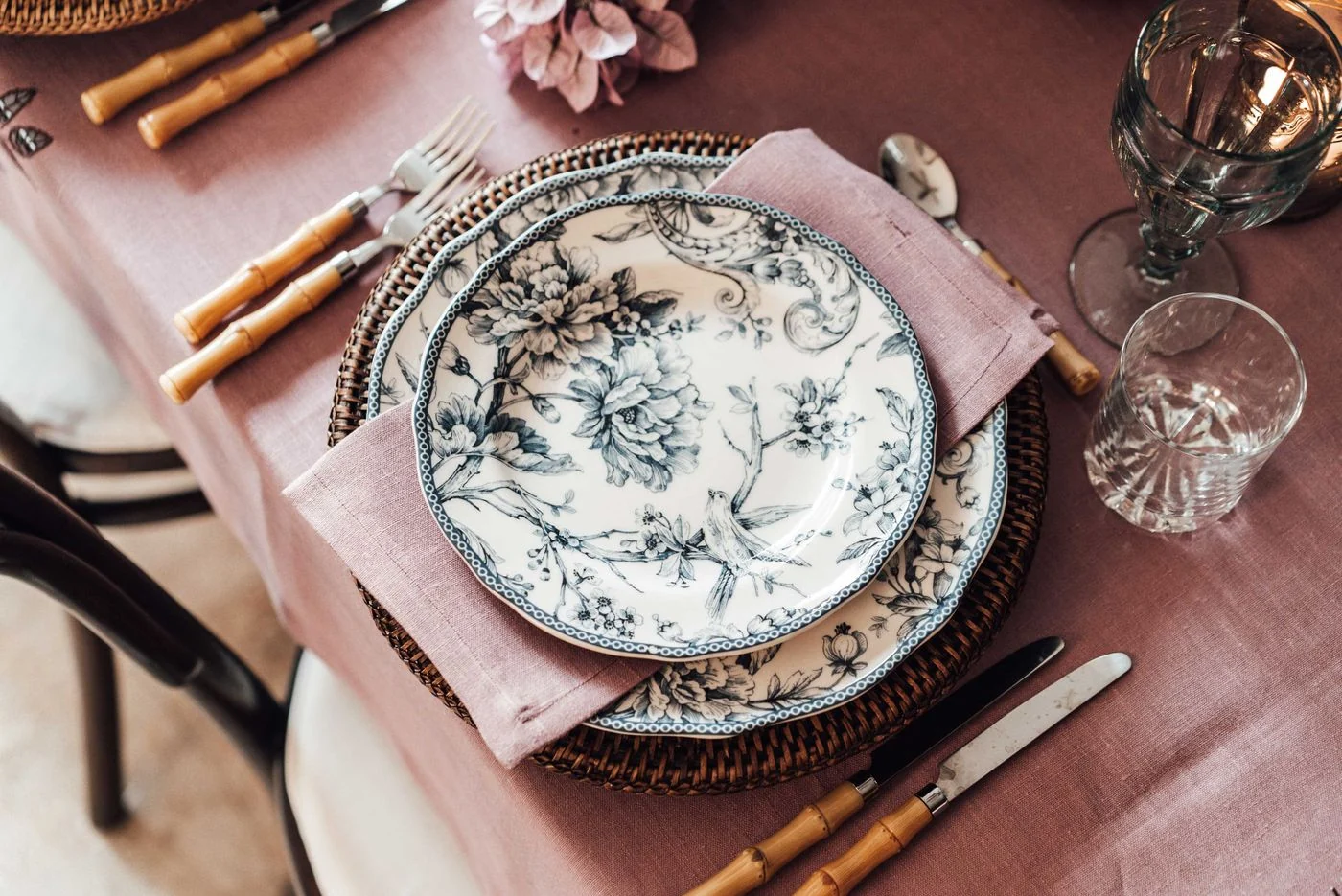
Toile-style scenic fabric brings more than color into a room. It contains little scenes, figures, branches, or buildings that the eye wants to examine. That detail can be appealing on a cushion or a small upholstered panel, but it also makes the print more demanding than a simple stripe.
Before choosing where to use it, unfold enough fabric to see the full repeat. A small sample might show only a tree or a pale background. The finished curtain could reveal several large figures across its width. You want to understand the whole image, not just the colors along one edge.
Choose a place where the drawing can be read
A small accent does not mean a tiny fragment. Give the print enough space for part of its scene to make sense. A cushion that cuts the main image awkwardly may be less satisfying than a somewhat larger panel with a clear section of the pattern.
Nearby fabrics can be deliberately ordinary. Plain cotton, a subtle woven texture, or a narrow stripe leaves room for the drawing. Adding another detailed scenic print does not necessarily create a richer room; it can make both patterns difficult to enjoy.
Look beyond the usual two-color pairing. The background tone matters as much as the printed line. A creamy ground may sit comfortably with warm wood, while a crisp white ground creates more contrast. Hold the fabric against the actual sofa or wall instead of deciding from an isolated online photograph.
Avoid turning the accent into a complete set
The room does not need matching toile curtains, cushions, and lampshades. If you already have one substantial toile item, connect it to the space through a plain version of one of its colors. That quieter repetition keeps the fabric from feeling disconnected without repeating the entire scene.
Consider the room's existing storytelling. A wall of small pictures, a patterned rug, and a scenic fabric all ask for attention in different ways. In that setting, toile might work best on one removable cushion that can be moved around until the balance feels right.
There is no need to invent a history for the fabric or describe a new print as a family heirloom. Its drawing can be enough. Let the reader of the room notice the trees, the figures, and the line quality, while the surrounding surfaces provide a little silence.